Hi. I’m Andy. And I’m obsessed with financial health.
You know how doctors are supposed to help you get healthier?
If you sprain your ankle and you go to the doctor, they should diagnose the sprain accurately and help you create a plan to get back on your feet, taking into account:
- your work (do you need to stand all day?)
- your capacity to take time off to rest (do you have sick or vacation days?)
- your ability to afford medications and physical therapy (what insurance coverage and benefits do you have?)
- any other concerns you raise
If you have a financial sprain, where do you go? Who do you talk to? Do you actually trust that your financial institution will understand what’s going on, diagnose the root cause, and help you create a plan to move forward?
Financial institutions are supposed to help you get financially healthier, too.
Research from the Financial Health Network shows:
80% of customers expect their financial institution to help improve their financial health. Only 14% feel that their financial institution actually delivers.
Leading financial institutions understand that their core responsibility is improving customer financial health—not only because it’s the right thing to do (it is), but also because financial health drives improved engagement, retention, and growth.
In other words: if you actually meet each individual customer where they are, genuinely understand where they want to go, and help them get there, you build better customer outcomes, and better customer outcomes build your business.
If you run a medical practice, you know that in order to grow your business, you need to understand the reality of what your patients are experiencing so that you can diagnose key needs accurately and solve problems accordingly. That’s how you build a trusted, long-term relationship with your patients—and a financially sustainable operation.
It sounds obvious. And it is, at the strategic level.
But the operational infrastructure for financial health barely exists.
If you run a wealth management practice inside a financial institution, you will have an intake process to understand your client’s values, needs, goals, and risk tolerance, and you’ll translate that into a plan you’ll review with them, then execute and monitor on a regular cadence. The margins in wealth management are high enough to support this kind of tailored approach.
At scale, though, we run into challenges:
- How do you provide individualized guidance to millions of customers, some of whom never set foot in a branch?
- How do you track the impact of individualized guidance on business outcomes that cross product lines, such as improved customer LTV?
Many financial institutions have built pieces of this. They have financial education modules for budgeting basics. They have automated investing options for customers who’ve just built a six-month emergency fund and said, “now what?” They have mortgage prep programs and tools.
What they don’t have is the infrastructure that connects all these pieces in one loop, from diagnosing needs through evaluating outcomes for both the customer and the business.
We’re inspired by similar infrastructure in healthcare.
You know who else has to track individualized guidance to millions of customers, and track the impact of that guidance on LTV?
Hospitals.
And what is the foundational data element that anchors this infrastructure?
The electronic medical record (EMR).
The EMR is the patient chart. It says: You came into the office with an intensely painful ankle. Your doctor did an exam and concluded you had a sprain. She recommended over-the-counter pain medication, an ankle brace, and physical therapy, after confirming you have enough sick days, childcare coverage, and insurance coverage to follow through on the plan. You had a follow up appointment four weeks later, at which point you were able to walk comfortably from one end of the room to the other without your brace.
The EMR answers four key questions:
- What was your diagnosis?
- What treatments did the doctor recommend?
- What treatments did you actually use?
- At follow up, how did your condition change?
In aggregate, enough EMRs answer a vital fifth question:
- What actually works to improve a diagnosis in the messy, real world, while trying to run a financially sustainable organization?
Every organization trying to operationalize financial health independently discovers the same five questions.
We didn’t invent the financial health workflow. Every single one of our clients, from a major US credit bureau to one of the largest credit unions in the country, discovered the same five questions independently.
Our clients were already trying to understand, at an individual level:
- What does this person need most in their financial life right now?
- Based on all of our content, community, services, and products, which resources would help most right now?
- Which of our recommendations actually stick? Where does this person engage most?
- When we follow up, how has this person’s financial condition changed?
Then, in aggregate:
- What actually works to improve financial health in the messy, real world, while trying to run a financially sustainable organization?
This is akin to a clinical workflow for patient care—for personal finances. Our clients, each in their own unique ways, are figuring out how to do effective, financially sustainable financial health workflows at scale.
It’s personalized medicine in the financial world.
The Financial Health Record™ (FHR) connects the dots.
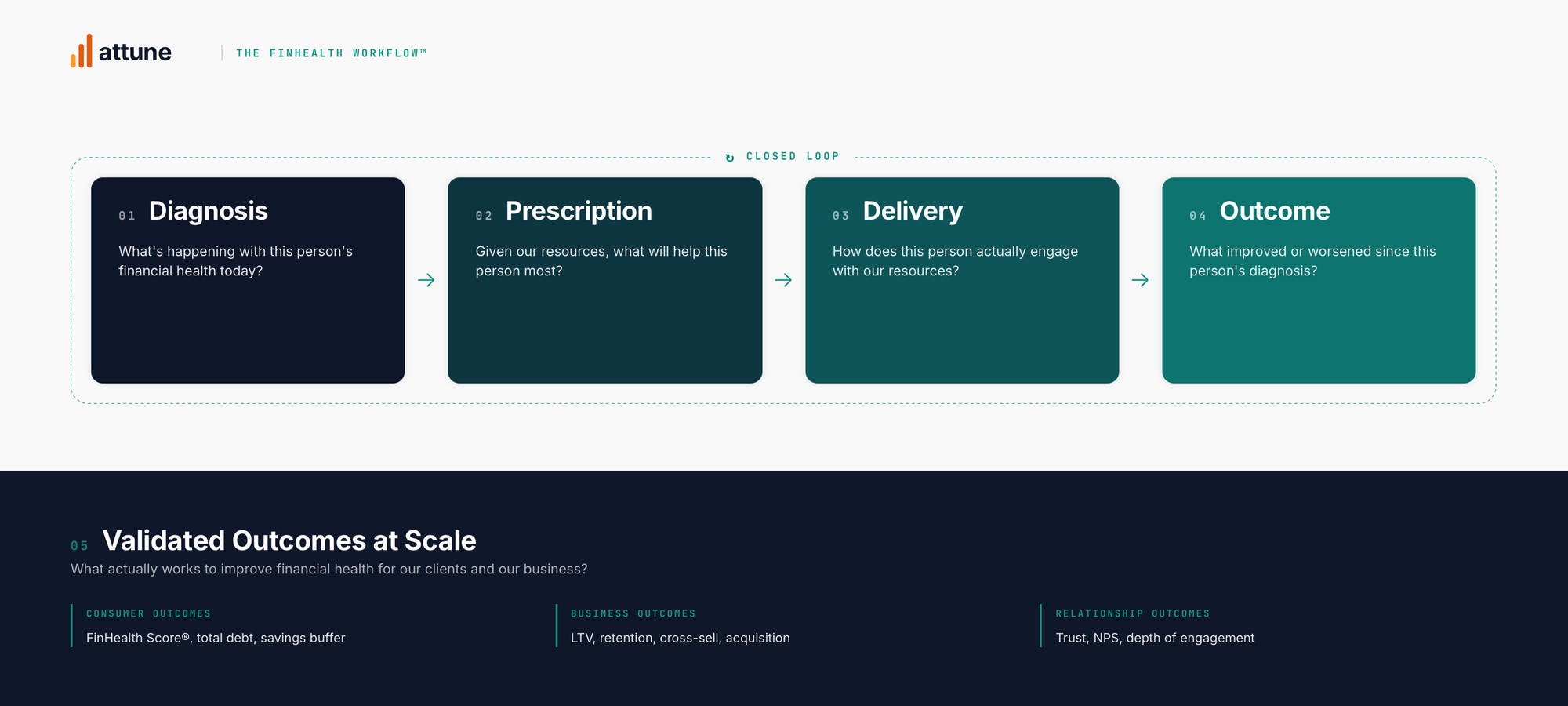
Just as clinical workflows write to electronic medical records, financial health workflows write to electronic financial health records. The FinHealth Record™ is a single record—clear, structured, easily readable and accessible by both humans and machines—that shows you:
- Diagnosis: What’s happening with this person’s financial health, right now?
- Prescription: Given all of our resources, what will best help?
- Delivery: How does this person actually engage with our resources?
- Outcome: What, if anything, improved or worsened since diagnosis?
Then, when you look at FHRs in aggregate, you see:
- Validated Outcomes: What actually works to improve financial health in our context, our organization, with our clients, while keeping our practice financially sustainable?
Medical care isn’t impossible without EMRs—but it’s a lot harder than it needs to be. EMRs are the data infrastructure that make clinical workflows operational. Likewise, the FinHealth Record™ is the data infrastructure that makes financial health workflows operational.
Build the FinHealth Record™ with us.
We started out as a financial health diagnostics company: born and incubated inside the Financial Health Network, we are FHN’s exclusive technology partner for FinHealth Score® implementation. The FinHealth Score® is the industry standard measurement for financial health—if you need a single place to start measuring, this is it. We make it easy to embed the FinHealth Score® into your products, platforms, and commercial services, whether you need a white-labeled diagnostic or an API to build your own assessment experience.
What we realized, over years of implementing the FinHealth Score® across financial institutions, is that correctly diagnosing consumer financial health is just the first step in the workflow. Our clients kept asking us: How do we know what to provide post-assessment? Can you train our staff in how to talk to people? Can you train an AI model to provide personalized guidance at scale? Can you track engagement with the resources we provide? Can you help us see whether any of it worked—to improve financial health, and to improve our bottom line?
Today, we’re a Financial Health Record company: grounded in our Financial Health Network roots and our deep learnings through implementations reaching millions of consumers, we’re building the infrastructure layer that connects the dots from initial diagnosis through outcomes for both the individual and the financial institution. Think of us as the MyChart for financial health.
We’re excited about making it way easier for financial institutions to help all of us get healthier, no matter where we’re starting, and no matter what our goals are. Just as healthcare works best when personalized, so does financial healthcare. Until now, even the most visionary organizations had to hack together point solutions to build toward financial health for all. Today, we’re building the infrastructure to make financial health for all an operational reality—across product lines, across channels, across languages.
Help us make it better. If you’re responsible for operationalizing financial health in your organization, let us know:
- Where in the workflow are you most stuck? Is it diagnosing needs? Bridging diagnosis to existing resources? Tracking engagement? Following through on outcomes? Connecting individual activities to the bottom line?
- What are you accountable for this quarter, this half, this year—and what’s standing in your way? What would removing those obstacles look like in your world?
From one financial health nerd to another: we’d love to meet you.
FAQ
What is the FinHealth Workflow™ (FHW)?
The FinHealth Workflow™ (FHW) is the process all organizations trying to operationalize financial health independently discover. It’s a four-beat loop: Diagnosis, Prescription, Delivery, Outcome.
- Diagnosis accurately describes an individual’s financial health state and current needs.
- Prescription offers relevant recommendations based on the diagnosis.
- Delivery tracks engagement with prescriptions—recommendations only help if someone actually uses the tools available to them.
- Outcome monitors what happened over time, for both the individual and the provider.
In aggregate, analyzing the data from these four beats creates a fifth element:
- Proof demonstrates what works to improve financial health outcomes for individuals and financial sustainability for financial institutions across an entire customer base.
What is the FinHealth Record™ (FHR)?
The FinHealth Record™ (FHR) is a single record—clear, structured, easily readable and accessible by both humans and machines—that shows you how an individual's financial health is changing over time, and how that trajectory connects to your business.
It’s the MyChart for financial health: an electronic medical record for your financial life.
How is the FinHealth Workflow™ (FHW) different from a customer lifecycle?
We’re big fans of customer lifecycle work. Our head of go-to-market, Claire Suellentrop, literally co-wrote the book on Customer-Led Growth™.
That said, across our work implementing the FinHealth Score® in financial institutions large and small, we’ve noticed that financial health work needs domain-specific adjustments that more general customer lifecycle models miss.
As just one example, customer engagement is too broad a category to be useful; the specific engagement patterns with specific resources we want to see depend entirely on the customer’s objective financial situation and subjective values and goals. “See customers login more often” may not actually do anything for financial health, even if it’s a standard engagement metric. “See customers who are drowning in credit card debt consolidate their debt into a lower-interest personal loan, pay off that loan with zero late payments, and improve their credit score by 50 points in the process” is a much more compelling engagement story for financial health that provides value for both the consumer and the financial institution.
Who is the FinHealth Workflow™ (FHW) designed for?
The FinHealth Workflow™ (FHW) is designed by and for institutions who know that:
- Improving consumer financial health is a business driver.
- Driving positive results requires embedding financial health in operations.
- Operationalizing financial health requires creating credible and compelling consumer messaging.
Who built the FinHealth Score®?
The Financial Health Network, the world’s leading authority on financial health, developed the FinHealth Score® through years of research and testing across survey and transaction data in partnership with the University of Southern California.
The FinHealth Score® is an objective, holistic assessment of financial health deployed across millions of consumers. It provides a quick snapshot of overall financial health, which is burdensome to build using other data sources, particularly for consumers who do not have a single primary financial institution and conduct their financial lives across many depository institutions, lenders, and fintech apps.
How does Attune relate to the Financial Health Network?
The Financial Health Network created Attune in 2019 to make it easier for financial institutions to implement the FinHealth Score® at scale. Today, Attune is the Financial Health Network’s exclusive technology partner for FinHealth Score® implementation. Born and incubated within the Financial Health Network, Attune offers enterprise-grade infrastructure, supports high-quality implementation, and enables scalable measurement. If you want to integrate the FinHealth Score® into your technology products, platforms, or commercial services (mobile apps, online banking, HR systems, APIs, etc.), reach out.
What’s the difference between the FinHealth Score® and the FinHealth Record™?
The FinHealth Score® is the industry standard for objective assessment of consumer financial health. The FinHealth Record™ is the longitudinal consumer record that connects diagnostics, including the FinHealth Score®, to prescriptions, deliveries, and outcomes for both the consumer and the financial institution. The FinHealth Score® shows you a point-in-time snapshot of consumer financial health; the FinHealth Record™ shows you how and why consumer financial health changes over time—and how those changes relate to your business.
About Attune
Attune helps financial institutions operationalize financial health at scale. Born and incubated inside the Financial Health Network, Attune is FHN’s exclusive technology partner for FinHealth Score® implementation. Our infrastructure supports the full FinHealth Workflow™ from diagnosing financial health to prescribing and delivering resources to proving outcomes for both the consumer and the financial institution. If you’re responsible for operationalizing financial health at your organization, we’d love to meet you.